Showing posts with label Archive. Show all posts

Thursday, July 5, 2012

Shy Town Summer


The Art Institute of Chicago and Millenium Park

By Pam Paulson

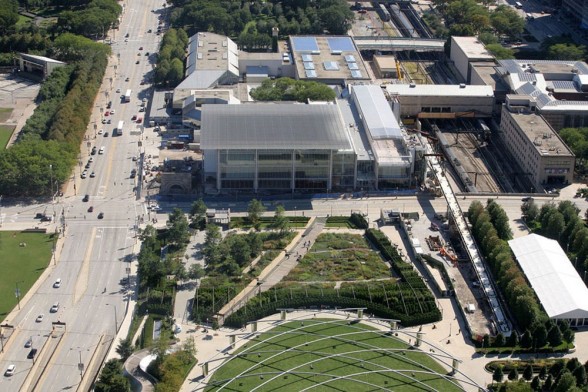
Stepping off the plane, Renee and I were engulfed by an ocean of hot air. Ninety-five degrees and 103% humidity (as our waiter later remarked). We caught a cab straight to the Art Institute of Chicago and met up with Mark Pascale. Mark is curating a show of Martin Puryear’s works on paper and invited us to discuss the prints we’ve made with Martin over the last 11 years. Graciously, Mark gave us a welcoming tour of the newish Renzo Piano addition, including the spacious gallery Martin’s exhibition will occupy. The light in the new section is refreshing, with windows overlooking native prairie gardens.

Pam Paulson in the Print Room at the AIC
 Mark further indulged us by taking us into the cavernous storage rooms of the works on paper collection, where row upon row of large flat files housed works slumbering in a climate-controlled stupor. Mark opened drawers and unshelved framed works, rousing Lee Bontecou etchings printed by Tatyana Grosman, gigantic Russian war posters, a dog collage by Joan Brown, and a charcoal study by Kerry James Marshall that I will never forget. Next up was the conservation department, where we talked glue theory with the conservators and enjoyed inspecting all their work areas and tools.

Finally, we found repose in the study room in the company of “Profile” by Martin Puryear and kicked back for an overview of the material that has been gathered to date for the show. Last fall, we shipped 99 working proofs and miscellaneous ephemera from our projects with Martin to the Art Institute to document the process of making the prints. It is really amazing to see this idea for the exhibition take shape.
Renee and Pam infront of the Kapoor

Mark visited Martin a few months ago with Ruth Fine (curator of special projects in modern art, National Gallery of Art) and Harriet Stratis (head of paper conservation at the Art Institute) to take a look at his personal archive of works on paper. Martin studied printmaking in Sweden and made highly successful prints early in his career. Renee and I had glimpsed these early works the first time we visited Martin’s studio. It was great fun to be virtually reintroduced.
Exiting the museum, we swam over to Millennium Park, strolling beside smartly designed fountains full of hot Chicagoans cooling themselves in the mist.  We wound our way over to the fun house mirror, “Cloud Gate” (Anish Kapoor’s monumental bean) and around to Gehry’s Jay Pritzker Pavilion. All wows!


The next day we looked at all the working proofs and the correlating edition prints, analyzing how we got from A to B. Not always easy to recreate, but thanks to usefully redundant documentation, we were satisfied we had it right. Mostly!

Later, after a quick walk to the lake, we met up with our old friend Stephanie Sherman for drinks and dinner at Gage, across from the museum. Stephanie (an amazing art professional) introduced us to the very handsome Billy Lawless, who owns Gage as well as Henri, its sister restaurant next door. We relaxed with a great cheese plate, fine martinis, a venison burger, and the fabulous staff. Then it was on to Henri for a memorable dessert at the bar.

Andy Cutting & Brice McCoy at Henri

Thankfully, the next morning, the temperature had backed down, and rainclouds mitigated the blazing sun. Skirting downpours, we paid a visit to Kerry James Marshall’s studio. Kerry is an amazingly productive individual. He has multiple projects in the works and then some. We were delighted to see several of his models, who closely resemble the one he worked with while in our studio.
Barbi Dolls at KJM's studio
Of great interest to me are the costumes Kerry and his assistant have designed and sewn for his dolls/models to wear when he draws them. They intentionally avoid recalling a discernible time period yet remain oddly familiar. The use of oversized elements like buttons and textures from the ribbing of socks upends the expected.
We boarded the plane back to the Bay Area exhausted and inspired. However, we were certainly not as exhausted as this guy in Renee’s row.


Face plant sleeper.

Thursday, March 1, 2012

15 Years: Part 2

When two people start a business they don’t often think about the historic perspective. That would seem a little grand. So it’s counter intuitive that two women as modest as Pam Paulson and Renee Bott would think about their work in this perspective from the outset. However, they both knew that the work they would produce at their press, the collaboration between master printers and renowned artists would be of interest to curators, collectors, historians, and artists at some point in the future. 
In this interview we asked founders Pam and Renee and Gallery Director Rhea Fontaine-Charlot’s perspective on the press at fifteen.

-Kenneth Caldwell

Pam, Rhea and Renee in the gallery, 2006


Q:                                 
Now that you have been in existence for fifteen years, there must be a substantial archive.

Renee Bott:                                 
That’s true. We consider every print that we rip up or keep to be a record of what we're doing. Along with that, we document the projects. We have a time capsule that plots our history. We started that from the very first day. We understood that if we created something, we wanted it to have a legacy as we move forward.

Paulson Bott Press showroom

Q:                                                    
How does the idea of the archive, with all of its evidence and documentation, influence your process?

Pam Paulson:                              
Perhaps it helps us to be even more careful about whom we choose to work with. When there is catalog raisonné of the work we want to be able to look back and see a strong vision.

Q:                                                    
How have the projects changed over the last few years? How has your thinking changed?

Bott:                                               
When we consider whom to invite now, we start by asking ourselves the question, where does this artist fit into our overall program as it moves forward?

Rhea Fontaine-Charlot:          
We are interested in a broad platform with a mix of artists. We don’t want to be predictable, and we are very focused on artists who add to the conversation in the realm of the work that they are doing, not just what we are doing.

Pam and Renee with Ross Bleckner

Bott:                                               
It's very difficult to invite someone to come and spend two weeks with us and then work hard, long hours every day if it’s someone whose work you're not totally excited about.

Q:                                                    
Let’s talk more about the process in the studio. When an artist comes here, one of you is assigned to them?

Paulson:                                        
Renee and I take turns being in charge of a project.

Bott:                                               
There is always a master printer in charge to streamline decision-making and communication. When you are building a print, it is like building a house. You don't want a carpenter doing plumbing before it's ready.

Paulson:                                        
It's like one chef in the kitchen and a bunch of sous chefs. Things get delegated throughout the project. I may do the color; Renee's making the decisions about the plate-making. You always find the strongest person or the person that’s right for the job.

Bott:                                               
For example, a younger printer might end up working in the acid room, allowing the master printer to be with the artist. Critical communication happens right after you've pulled a print. Decisions are made: What are we going to do next? How are we going to do it? Especially with an artist who has never made prints before, it's a teaching process. So you want to introduce concepts and ideas in a way that they can see how it's going to help them get to where they want to go.

Fontaine-Charlot:                     
It's a really tough thing, because we're trying to keep the artist busy and engaged, but there's a lot of technical work to be done. So the printers are really juggling. It demands a lot of energy.

Q:                                                    
I want to know more about the collaboration with the artist.

Paulson:                                        
Often we visit their studio and discuss what ideas they have.

Bott:                                        
When they come here, we ask them what size print they'd like to make and narrow it down to a few images or ideas. Then we cut a piece of copper and stick it in front of them and say, go at it, one-way, or the other.

Paulson:                                        
Most artists have done some thinking before they come here. It's not like they walk in with a completely blank slate, because that's not usually comfortable for them.

Radcliffe Bailey

Q:                                                    
But that idea could utterly change?

Paulson:                                        
Completely.

Bott:                                               
And sometimes their ideas are so fixed, it takes a few days to work through to something that works with the etching process.

Paulson:                                        
There is a moment when they're actually looking at the proof you pulled, rather than the idea that's in their head. And they start responding, and that’s when the process really starts moving.

Bott:                                               
When Pam and I go to their studio and see what's up on their wall and start talking to them about it, that's when a lot of things start to click.  It's pretty rare that people come in and we have no idea what they're going to do. And yet, in this last project with Tauba Auerbach, she had a bunch of ideas that we had not discussed. Every day it was a different surprise.

Paulson:                                        
We went through so many different ideas, and she'd test one for a day or two or occasionally three to see if we could get the results that were satisfying to her.

Q:                                                    
Other surprises?

Bott:                                               
Then there was also Radcliffe Bailey. We showed him sugarlift, and he took off his shoes. He stuck his foot in the sugarlift and walked across the print. We had never seen someone do that before. We were washing his feet trying to get the ink off—just like Jesus.

Paulson:                                        
Chris Johanson came in and said, “I want to make the ugliest print I can make.” He did all these hard zigzaggy marks on five or six plates. Then when we put them all together, it was kind of a beautiful thing.

Chris Johanson

Q:                                                    
What about the future?

Fontaine-Charlot:                     
It is about staying true to our instincts.

Bott:                                               
We've learned to rely on good relationships.

Paulson:                                        
And that means making time to communicate with people, all kinds of people.

Bott:                                               
There are two sides, the commerce and the artists. I feel very strongly about keeping the artists in your heart. We would not be here without them. You have to try and be humble