Showing posts with label Gallery. Show all posts

Tuesday, October 1, 2013

Maira Kalman


This post is part of an interview I did with the artist/illustrator Maira Kalman for Paulson Bott Press in Berkeley. She is more comfortable with an assignment and a deadline than the process that takes place at a fine art press like Paulson Bott. But she used her skill of observation to gather a series of images that work together in a kind of grand collage.
 -By Kenneth Caldwell

What’s been the process of determining what prints you are going forward with?
We took all of these images and snippets and staticky things and put them together in one sheet. And then we went from there to doing individual plates and then putting them together and then separating. Back and forth.

How is printmaking different from working at home? What does it feel like?
When you’re alone in the studio, you have to make your decisions, for better or for worse. Here, when there are people who can give you feedback, I find myself in a bit of a fog, but not in a bad fog—in a very, very good fog.

So at home you don’t have assistants?
No. I have negative assistants. I have resistance. I’m just in my studio wandering around.

Does this have chin-collé on it then? Is this a sheet of gampi?
Yes.

That’s a whole new thing then. It’s a new effect, but it has luminosity.
Yes. I could paint on this. And I tried drawing some. This paper drives me crazy with happiness. I want like my whole life to be this.

Whose idea was it to print on cloth?
I wanted to print on cloth because I do a lot of embroidery stuff. And I thought, okay, it’s cloth, and then we’ll draw, and maybe try some embroidery. But the embroidery that I’ve tried feels unnecessary.

Mostly, 2012  A portfolio of 27 sugarlift aquatints and hardground etchings printed on linen.  Edition of 15


I love the use of the fabric.
For me that’s part of the process—that we went to a nearby fabric store and saw what they had—and they had wonderful things.

Can you talk about some of these images you brought with you to use for reference?
This is an airplane. It’s like the early airplanes.

Like Kitty Hawk?
Exactly, but it may be upside down. I’m not sure. And this was a dancer from New York. I cut out a lot of photographs, so this is a woman that performed a few years ago. Half the time I don’t know where I cut out the images from anymore, but she’s a dancer, and this is also a dance troupe. So the movements of people making it through the day, both intentionally as dancers, and then just how we move around really fascinates me a lot. There’s a man behind her in the photo, holding his hands on her shoulders. But she’s a little bit awkward.

There’s a stiffness, yes.
I’m always watching how people are walking, and following them and photographing how people walk and really struggle—a lot of yearning to be okay, and dignity, and being brave. Basically I think everybody’s very brave for getting up in the morning and continuing through the day. Sometimes people walking, people sitting and eating, are just heartbreaking. I love Diane Arbus when she went to visit the people in the home and the Halloween images of those people. That’s also a Lartigue, but the photo is of a woman looking up at this ball, and then it became something else. It became a woman holding a stick. And then there is the rollercoaster after Hurricane Sandy.

With these images, are you drawing into the copper plate?
I’m always drawing into the plate, either the hard ground or the sugar lift. It only took me four days to remember those four words—hard ground, sugar lift.

And now you’ve got chin-collĂ© and gampi too!
It’s like a nice poem.

I was going to ask you, does it feel a little bit like poetry—these scattered images or fragments that you’re tying together?
Yes. I think that the problem is, putting the word “poetry” on it—it depends what kind of mood you’re in: poetry can be a wonderful thing to say about something, and then, as a critic once said about me, “unnecessarily poetic.”

It’s a very different poem here in this arrangement than it might be in that arrangement.
Yes. I don’t want to forget the idea of a sense of humor along with the yearning and the sadness. There’s a lightness balancing the heaviness. And so poetry would imply one thing, and then just saying “I don’t know” would be the other.

Have you worked with poets?
No. But a lot of the things that I write or things in the books are poems. The dog says, okay, I’m going to write a poem now. I’m going to close my eyes and think of three things and then make a poem out of that. So there’s a lot of poetry and there’s a lot of songwriting in the children’s books. But I am collaborating with Gertrude Stein [in the set designs for the Mark Morris Dance Group’s production of Stein’s opera Four Saints in Three Acts]. So yes, I’m collaborating with a poet whom I never met.

She won’t get in the way.
I hope that if she were alive she’d go, “Great,” as opposed to, “Don’t you dare.”

Where did your idea of illustrating Elements of Style come from?
I found a copy of the book one summer and thought, “Oh my God, this is a crazy great book, and I need to illustrate it.” It’s the randomness of each sentence. The continuity comes from [Strunk and White’s] wit and the vivid cinematic images that they use. You don’t have to worry about a plot.

Do you want to come back to Paulson Bott Press and make more prints?
Of course I want to come back some time in the future when it all makes sense. I’ll go home and I’ll be able to moan and go, ugh, what was I thinking, or what was I not thinking? Really, it’s the beginning of a conversation.

You’ve been to Berkeley before?
I’ve been to Berkeley some other times, and I spent time in San Francisco installing the show at SFMOMA [about her late husband Tibor Kalman]. And then I came here to this gallery, and I said, “This is an amazing space. I love being here.”

Have you been able to explore a bit?
Well, I walk from my bed-and-breakfast in the morning. It’s over a mile. But that’s also the graph of the day—that sometimes you’re just sitting there like a stunned animal, not knowing what’s going on. We are animals that sort of freeze, and then—well I guess it’s like a possum, but a possum plays dead for something else. But I feel like sometimes I’m an animal that all of a sudden is dead. And then all of a sudden I come back to life.

So much of your work depends on observation. What do you see on your walks?
One of the things I did in Rome was go watch people pray, because I was trying to say, “What exactly are you doing? What are you doing on your knees? What do you think is going to happen here?” The intensity of people publically displaying their emotions and their grief and their hope, it’s incredible. Plus in Naples there were a lot of places where people are in confession and the priest is just sitting up, kneeling opposite them, not in a little contained cubicle, just open.

I think the concept of prayer is so interesting, because it’s one idea that can’t be defined, because each individual completely changes it.
The thing is that if you’re in the formal construct of a church or a synagogue and you’re praying to a deity, as opposed to praying for the strength to deal with whatever tragedy might befall you, and you are looking for a deity to save you, that feels delusional.  I say “Oh my god” a thousand times a day.  Then I say, “But I don’t believe in God.”  And i am really not sure which statement is true.

Wednesday, July 24, 2013

Martin Puryear

By Rhea Fontaine

I can remember years ago, when I first interviewed for the position at Paulson Bott, my friend and former colleague, Sherry Apostol encouraged me by stating, “What a great place, Rhea.  You have got to work for them; they work with Martin Puryear!”

Before I had met Martin in person, another colleague compared the experience of his company with that of being in the presence of the Dali Lama.   When I met Martin in 2002, I realized that she was right.  His grace is remarkable.  In his company, one knows they are in the presence of greatness.  Martin is very soft spoken, but when he speaks, people listen. 

Martin Puryear, Reliquary, 1980, Gessoed pine; Martin Puryear, Self, 1978, Stained and painted red cedar and mahogany. Photo Courtesy the New Museum
We also listen to his art-- the vibrations, the emotions released from his sculptures.
They speak of the natural world, the human spirit and world history.  They nod at, bow to and break down our notions of the object.  Like Martin, they are quiet, magical and sublime. 

Martin employs wood, mesh, stone and metal to create forms that resist identification.  They evoke the future and the past, both forging ahead and leaning back.  They excite and provoke and comfort. 

Martin Puryear, North Cove Pylons, 1992-5, Granite and stainless steel
It is my greatest pleasure as Gallery Director at Paulson Bott, to introduce his work to those who have yet to discover it.  I often resist my temptation to scream, “What? You don’t know who Martin Puryear is?!”  “Haven’t you heard, the critic Robert Hughes has only declared him to be ‘America’s Best Artist’!”


Martin Puryear, This Mortal Coil, 1998-99 Red cedar, stainless steel cable, aluminum, and muslin
Martin’s first comprehensive show in the California bay area was in 2001 at the Berkeley Art Museum.  Sadly, it’s opening day was September 11th and many missed the exhibit for obvious reasons.  Slight redemption took place in the fall of 2008  when his retrospective, Martin Puryear, traveled to the SFMOMA.  It was an exciting chance for the bay to experience his impressive oeuvre.   I remember speaking with a friend who had just seen the show, and she stated, “I’ve always admired the images I’ve seen of his work but standing next to the sculpture in person literally gave me goose bumps.” 

After the opening, the SFMOMA hosted a spectacular dinner at the St. Regis to honor Martin.  Neal Benezra spoke to the group and expressed how fortunate we all were to be sharing such a momentous occasion with an artist of his caliber.   It is indeed our privilege at Paulson Bott Press to engage with an artist that we know will mark our time and leave a lasting legacy in the art world and beyond.

Martin Puryear, Phrygian, 2012 Color Aquatint Etching; Published by Paulson Bott Press

Tuesday, October 30, 2012

Collector’s Profile: Martin Maguss and Mari Iki

By Renee Bott

Martin Maguss and Mari Iki / photograph installation by Sean McFarland
Mari Iki and Martin Maguss are San Francisco collectors. They are avid collectors and have amassed an impressive collection with a modest budget.  Over the years, they have purchased works by artists such as Andy Warhol, Robert Rauchenberg, Keith Haring, Francis Bacon, Nan Goldin, Gary Simmons, Vik Muniz—the list goes on. They have also been great supporters of the many local art galleries.  Pam and I met them in the late 1990s at the first Blackman art fair at Fort Mason where they purchased a small print from us.  At a recent dinner for the artist Gary Simmons, we found out that Martin began collecting art in high school. I wanted to see their collection, and I asked if I could interview them.


Q:                            Martin, when did your passion for collecting art begin?

Martin:                   My dad instilled the values—you save up, then you can buy what you want. Growing up in Canada, I was excited about American culture. In high school, Lichtenstein and Warhol were on my radar. I had a part-time job and saved enough to buy my first piece.

Q:                            The Lichtenstein was the first piece you purchased?

Martin:                   Yes. I showed it to my dad, and said, “I bought this artwork by an American artist who I absolutely admire, Roy Lichtenstein.” My dad asked me how much I paid for it, and when I told him, he was livid. I said, “Wait a minute. You told me to save, and if I saved enough money, I could buy whatever I wanted. So this is a win for everybody. Now I want to go to New York and meet Andy.” My dad said, “Andy who?” I told him, "I want to meet Andy Warhol."

Roy Lichtenstein, Hand and Foot, 1964 Color Silk Screen Print
Q:                            How did you know about these artists?

Martin:                   I was attracted to pop culture. While in high school, I’d also spend my free time in the National Gallery of Canada looking at Claes Oldenburg’s Bedroom Suite and the work of James Rosenquist. Expo 67 was also a big influence, because the American pavilion exhibited all the Pop artists. I travelled to Montreal to see it!

In university, I majored in graphic design and photography. I spent a great deal of time with close friends, having wonderful dialogues about the current artists—Julian Schnabel, Francesco Clemente, and others in the early 1980s.

Q:                            Did you get to meet Andy Warhol?
Dining Room

Martin:                   Yes. I got on a Greyhound bus and went to New York. It was a different time, you could just do it. I’d met him a couple of times in Toronto as well. Meeting him really did change my perspective on art.

Q:                            So when you and Mari met, your relationship revolved around art?

Martin:                   We were talking, obviously, a lot about art. She took me to the Berkeley Art Museum to see this painting that she just loved.

Mari:                      I said, “Oh, you have to see this museum, because it’s just great.” I would go there all the time. I showed him my favorite piece—a painting by Francis Bacon.

Q:                            Mari, was there a conscious moment when you decided to start collecting?

Mari:                      For as far back as I can remember, whenever I travelled with my family, I went to museums. I stood in line to attend the Avedon retrospective that David Ross curated at the Berkeley Art Museum. I had all these posters of amazing shows that I’d been to. Later, after Martin and I met, we went to the Fraenkel Gallery.

Martin:                   That was October 1984.

Mari:                      Martin asked Jeffrey Fraenkel to show us the Mapplethorpe still lifes. They were gorgeous black and white images of orchids. I forget how much they were—$500, $700—but I just said, “Wow...that’s so much for a black and white multiple.” Martin told me, “You spend money on posters, you should think of getting the real thing. Like these photographs, they’re beautiful.” We never got one!

                                Before I met Martin, I used to go into the Stephen Wirtz Gallery, always looking at Raymond Saunders’s work. Later, I went in with Martin and looked at a Raymond Saunders print maybe ten times. Finally, with guidance from Stephen Wirtz, the Saunders print was the first piece that I purchased.
Nan Goldin's photograph: Skyline from My Window - NYC, 1999 anchors the entry way wall.
Q:                            But did you have to agree on this, or was this your own endeavor?
Mari:                      That was my first contemporary art “acquisition,” but we do tend to agree.

Martin:                   The amazing thing about our relationship is if Mari and I see an exhibition, we will usually independently pick out the exact same piece. We have to work within a budget—we don’t have a lot of “disposable income”—we both have regular jobs.

Mari:                      Frankly, when we’re interviewed about collecting, it’s to show that anybody can collect.

Q:                            There must have been a point at which you realized...

Mari:                      We saw a segment on 60 Minutes in 1995.

Q:                            It’s not about the Vogels is it?

Mari:                      Yes—Herb and Dorothy!

Martin:                   We had an epiphany. They were such an influence to us! They didn’t have a fancy New York City lifestyle, and they had a comparable budget to work with. We thought, “Here are people who think in a similar way.”

Mari:                      They have some of the same priorities! It’s okay to not want to get a new sofa or something, but to purchase art. Most of our decisions revolve around looking at or purchasing art. Our friends thought we were crazy.


Vik Muniz's ceramic plate Medusa, 1999 rests on the dining room table.
 Q:                            I want to focus for a moment on the idea of curating a collection. Do you have an overarching idea for your collection, or is it based on a gut reaction?

Mari:                      It is an informed gut reaction. I once asked a friend why a museum director had spent extra time with us. He said, “Because I explained to him that you have a collection.” I said, “But we don’t have a collection. We just collect.”

Q:                            Is that how you still think of it today? Or now that you have all this work, do you feel a sense of responsibility?

Mari:                      We do feel a certain responsibility. What happens to it when we’re not here? We haven’t really come up with...

Q:                            The perfect plan?

Martin:                   Yes. The one thing we’re consistent about…for any work in our collection, we will always loan for educational purposes. It’s for the betterment of the artist’s career; it’s not about us, it’s for them.

Q:                            What about your relationship to the artists who make the work? Is it important to meet the artist? Or does that change the relationship?

Mari:                      When we can meet them, it’s wonderful. For example, Sean McFarland, who shows at Eli Ridgway Gallery, is an emerging photographer, and we’ve learned a lot about his work by getting to know him.

Martin:                   I’ve always said to Mari, if there’s an opportunity to meet an artist, we should. I remember when Mari met Diebenkorn and Thiebaud; I met Warhol, Haring, and others. If you can hear them talking about their work, that’s the best!
Deborah Oropallo's painting High Heat (Respirators), 2002 in spotlight

Q:                            There’s no substitute for that.        

Martin:                   You’ve worked with Martin Puryear, Caio Fonseca, Radcliffe Bailey, Gary Simmons, and other artists that we admire. Artists that are continuing the line of creativity. Whether they work with paint, wood or other media—when they come into your studio and address another medium, the creativity is all the same! For us, there’s little distinction between painting, drawing, and works on paper.

Q:                            What is your advice to the novice collector?

Mari:                      Look everywhere, read a lot, and then remember to look at the new and emerging artists and galleries.

Martin:                   Mari and I spend an inordinate amount of time not only looking at work, but also talking about work. We’re always looking, even when we know we won’t be purchasing. We never buy for investment.

                                There are always opportunities for young collectors. Someone might not have the budget for a Kerry James Marshall painting, but they could consider one of his amazing prints.


Thursday, August 2, 2012

"Have Been Swimming"


By Rhea Fontaine-Charlot

The work of Isca Greenfield-Sanders has the ability to convert even the most jaded person into a hopeless romantic. Her paintings and etchings often seduce the viewer into a wistful state--suddenly yearning for days past or simply imagined. 

Isca Greenfield-Sanders: Wader I (Pink), Wader II (Pink), Wader I (Blue), Wader II (Blue), Pikes Peak, Mountain Stream, 2012

What better season to celebrate her six new etchings than summer? Isca's ocean waders and mountain bathers inspired all of us at Paulson Bott Press to share our own youthful images of summers spent by waters.


The Mertens-Bott clan, Martha's Vineyard, 2007
Z, Feather River, 1994
Sam, Stinson Beach, 2007

As the daughter of an English teacher, I am deeply programmed to live for summer days.  The three remaining seasons have always seemed but preludes to the main event. Growing up, my sisters and I spent long days in the Sierra, soaking up the fresh air and sunshine and jumping off rocks into lakes.

The Fontaine sisters, Mirror Lake, 1988

It is always the artist that inspires us to be, once again, at the water's edge, where we are living life to its fullest.  The joy of my summers at the lake is best expressed in one of my mother's poems:


Have Been Swimming

Summer's one
English Lesson
Came to me
As I frolicked
In the lake,
Whose waters
By August warmed
Let limbs
Cast easy strokes
Long reaching
Like love's memory
Washing over me.
By simplicity buoyed,
I floated free
Beneath a blue
That bore both
Sun and moon
To light my study
Of the Present Perfect tense.

Catherine Fontaine 8/02

Levi and Rhea, Merced River-Yosemite, 1977


Isca Greenfield-Sanders, Walk with Daddy, 2008

Thursday, July 5, 2012

Shy Town Summer


The Art Institute of Chicago and Millenium Park

By Pam Paulson

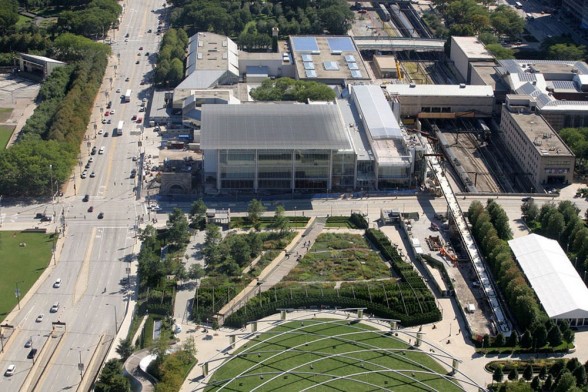
Stepping off the plane, Renee and I were engulfed by an ocean of hot air. Ninety-five degrees and 103% humidity (as our waiter later remarked). We caught a cab straight to the Art Institute of Chicago and met up with Mark Pascale. Mark is curating a show of Martin Puryear’s works on paper and invited us to discuss the prints we’ve made with Martin over the last 11 years. Graciously, Mark gave us a welcoming tour of the newish Renzo Piano addition, including the spacious gallery Martin’s exhibition will occupy. The light in the new section is refreshing, with windows overlooking native prairie gardens.

Pam Paulson in the Print Room at the AIC
 Mark further indulged us by taking us into the cavernous storage rooms of the works on paper collection, where row upon row of large flat files housed works slumbering in a climate-controlled stupor. Mark opened drawers and unshelved framed works, rousing Lee Bontecou etchings printed by Tatyana Grosman, gigantic Russian war posters, a dog collage by Joan Brown, and a charcoal study by Kerry James Marshall that I will never forget. Next up was the conservation department, where we talked glue theory with the conservators and enjoyed inspecting all their work areas and tools.

Finally, we found repose in the study room in the company of “Profile” by Martin Puryear and kicked back for an overview of the material that has been gathered to date for the show. Last fall, we shipped 99 working proofs and miscellaneous ephemera from our projects with Martin to the Art Institute to document the process of making the prints. It is really amazing to see this idea for the exhibition take shape.
Renee and Pam infront of the Kapoor

Mark visited Martin a few months ago with Ruth Fine (curator of special projects in modern art, National Gallery of Art) and Harriet Stratis (head of paper conservation at the Art Institute) to take a look at his personal archive of works on paper. Martin studied printmaking in Sweden and made highly successful prints early in his career. Renee and I had glimpsed these early works the first time we visited Martin’s studio. It was great fun to be virtually reintroduced.
Exiting the museum, we swam over to Millennium Park, strolling beside smartly designed fountains full of hot Chicagoans cooling themselves in the mist.  We wound our way over to the fun house mirror, “Cloud Gate” (Anish Kapoor’s monumental bean) and around to Gehry’s Jay Pritzker Pavilion. All wows!


The next day we looked at all the working proofs and the correlating edition prints, analyzing how we got from A to B. Not always easy to recreate, but thanks to usefully redundant documentation, we were satisfied we had it right. Mostly!

Later, after a quick walk to the lake, we met up with our old friend Stephanie Sherman for drinks and dinner at Gage, across from the museum. Stephanie (an amazing art professional) introduced us to the very handsome Billy Lawless, who owns Gage as well as Henri, its sister restaurant next door. We relaxed with a great cheese plate, fine martinis, a venison burger, and the fabulous staff. Then it was on to Henri for a memorable dessert at the bar.

Andy Cutting & Brice McCoy at Henri

Thankfully, the next morning, the temperature had backed down, and rainclouds mitigated the blazing sun. Skirting downpours, we paid a visit to Kerry James Marshall’s studio. Kerry is an amazingly productive individual. He has multiple projects in the works and then some. We were delighted to see several of his models, who closely resemble the one he worked with while in our studio.
Barbi Dolls at KJM's studio
Of great interest to me are the costumes Kerry and his assistant have designed and sewn for his dolls/models to wear when he draws them. They intentionally avoid recalling a discernible time period yet remain oddly familiar. The use of oversized elements like buttons and textures from the ribbing of socks upends the expected.
We boarded the plane back to the Bay Area exhausted and inspired. However, we were certainly not as exhausted as this guy in Renee’s row.


Face plant sleeper.

Wednesday, April 11, 2012

Gary Simmons: An Account of Time

      Bonham Marquee 2012                         Chandelier Spin 2012

By Renee Bott


Some ideas take years to cultivate. Printers need a patient side.


In 1997 Paulson Bott Press was a year old.  We had several projects underway and were enjoying the exhilaration of starting a new business and achieving some success. In November of that year, Pam and I left our first studio in Emeryville for our second trip to New York to visit some artists.  Gary Simmons was the first person on our list; we had arranged to meet in his studio on a cold November morning.

Gary’s studio was located on one of the many floors of a vast studio building in Chelsea. At that time he had an exhibition up at Metro Pictures. He said the next few years were extremely busy for him, but he would consider our invitation to come to the east bay and make prints. 

In the years that followed, I was fortunate to see several of Gary’s exhibitions and installations. I always appreciate it when I experience a transcendent art moment. By this, I mean a moment when I connect to the work in a way that makes me want to remember what I saw, to remember how I felt when I stood in front of that piece. Gary’s installation at the Contemporary Museum of Art in San Diego in 1997 was a moment like that. 

Directly across from the main entrance to the museum, I could see his work on the far gallery wall. I didn’t hesitate; the force of his work pulled me in. I paused before his installation Gazebo.  It was a breathtaking, larger than life drawing of a gazebo on a dark charcoal wall with Gary’s signature “erasure” of the chalk drawn structure.  It was like a wild wind had encircled the porch. Or perhaps it was a fading memory. Rife with historical references the work conjured southern mansions and formal tea along with echoes of the long civil rights battles still being waged today. 

Gary Simmons: Gazebo, 1997


Erasure: Video of Gary Simmons at Paulson Bott Press by Bill Freais

Years later, in the fall of 2010, I picked up Gary from the Anthony Meiers Gallery in San Francisco. He and his assistant folded themselves into my Mini Cooper and we headed over to our studio in Berkeley for lunch and a tour of the press. He was serious about our invitation; it just took him a while to get around to accepting it.

Starlite Theatre 2012

Gary was immediately at ease in the studio, experimenting with everything available to try out on a copper plate.  With his presence the studio instantly had a different energy, the printers curious and watchful, eager to engage with this thoughtful and talkative artist.  It is a great feeling to be involved in the moment of an artist’s creation. Discoveries are being made, mistakes are happening. The trial and error of working with a new medium gives way to something new and magical. 

In November of 2010 Pam and I once again climbed the stairs to his New York studio.  We were in town to see the Armory Fair. By that Friday afternoon, we had already seen a whole lot of art and our feet were tired. The studio was pristine.  The walls were carefully arranged with his latest work, completed and ready to ship to Simon Lee in London for his opening there.  After the pandemonium of the art fair, Gary’s quiet studio was uplifting, like walking in to a cool cathedral on a hot summer day in Rome.  Pam and I sat down and admired his ghost ships and deck chairs. This was, hands down, the most exciting art we had seen in New York that week.

Gary worked at Paulson Bott Press for a week in the fall of 2011 and completed three prints. He came back for a few more days in January 2012 and completed the project, making three more images.  The first three prints reference Kubrick’s film The Shining. Two of the prints taunt us with the repeated type written line “All work and no play makes Jack a dull boy.”  The third, a large six panel piece depicts two ominously swinging turn of the century chandeliers from a scene of the hotel’s interior. Another related image is a spinning classical chandelier from a still of Hitchcock’s masterpiece Marnie . Simmons has a fascination with horror movies and related material including theater marquees, which are the subjects for two more of his prints. Images of the Bonham and Starlite marquees shimmer as if blinking out for the final time as they disappear from the American landscape.

Last month we returned to Gary’s studio to sign prints. We were delighted that the discussion touched on ideas for future projects. Gary explained that the process had led him to think about his mark making differently. That he had enjoyed the experience of spending more time in the space of making his drawings. Some things just take time.

All Work And No Play, 2011
  All Work Reversal, 2011